
The Queens Own Royal West Kent Regiment
Second Lieutenant J M Crombie
Second Lieutenant James MacHattie CROMBIE, 10th Battalion, Queens Own Royal West Kent Regiment, died of wounds, 2nd July 1917, age 20.
Son of Dr. James and Mary Marshall Crombie, of "Highden," Sidcup, Kent.
Educated at Merton Court, (established in 1899 in Sidcup) and
then from about 1908 he attended Epsom College which was originally founded to
help the sons of medical practitioners. Belonged to the Epsom College Officer
Training Corps for five years and was a cadet officer and head prefect during
his last year there. In June 1916 he gained a Military Exhibition at Christ
Church, Oxford. Following officer training at the cadet school he was gazetted
to the Royal West Kent Regiment.
1911 Census - 20 Hatherley Road, Sidcup - James Crombie, head, age 54, married, general medical practitioner, born Melrose, Roxburghshire; Mary Crombie, wife, age 48, married 21 years, 4 children, all still alive, born Londonderry, Londonderry; Gladys Crombie, daughter, age 19, single, born Sidcup, Kent; Ian Crombie, son, age 16, single, school, born Sidcup, Kent; James Crombie, son, age 13, school, born Sidcup, Kent; Edith Hoy, servant, age 20, single, domestic cook, born Sidcup, Kent; May Rich, servant, age 16, single, domestic housemaid.
His brothers also fell:
Captain Ian Osborne Crombie aged 21,11th Bn. Middlesex Regiment - died 28th July 1916. Buried at Bouzincourt Communal Cemetery Extension, Grave Reference II. F. 5.
Captain William Maurice Crombie,aged 25, Indian Medical Service -
died 17th February 1919. Buried Sidcup Cemetery, grave reference E. 28. 1.
19th November 1917, Probate - Crombie James MacHattie of Highden, Sidcup, Kent. Second Lieutenant, 10th Service Battalion, Royal West Kent Regiment died 2nd July 1917 in Belgium, Administration London 19th November to James Crombie, medical practitioner. Effects £266 6s 6d.
Buried at Lijssenthoek Military Cemetery, XIII. H. 8., Poperinge, West-Vlaanderen, Belgium & Commemorated on the Sidcup War Memorial & Merton Court Preparatory School Memorial.
Christ Church College, Oxford
University - 2nd Lieutenant James Machattie Crombie, 10th Battalion
Queen’s Own (Royal West Kent Regiment)
Date of birth: 1897
Buried at Lussenthoek Military Cemetery, Poperinge, West-Vlaanderen, Belgium;
Grave Reference: XIII. H. 8.
James Machattie was born in Bromley, Kent, the third son of
Dr James Crombie, a general practitioner trained in Edinburgh, and his wife Mary
Marshall Crombie of “Highden“, Sidcup, Kent.
The third brother, William Maurice Crombie, Captain, Indian
Medical Service died on 17 February 1919, and is buried in Sidcup
All three are commemorated in Bexley.
His Estate amounted to £266 6s 6d, administration granted to
his father.
Photographs & Document provided by Elizabeth Manterfield from Epsom College Archives.
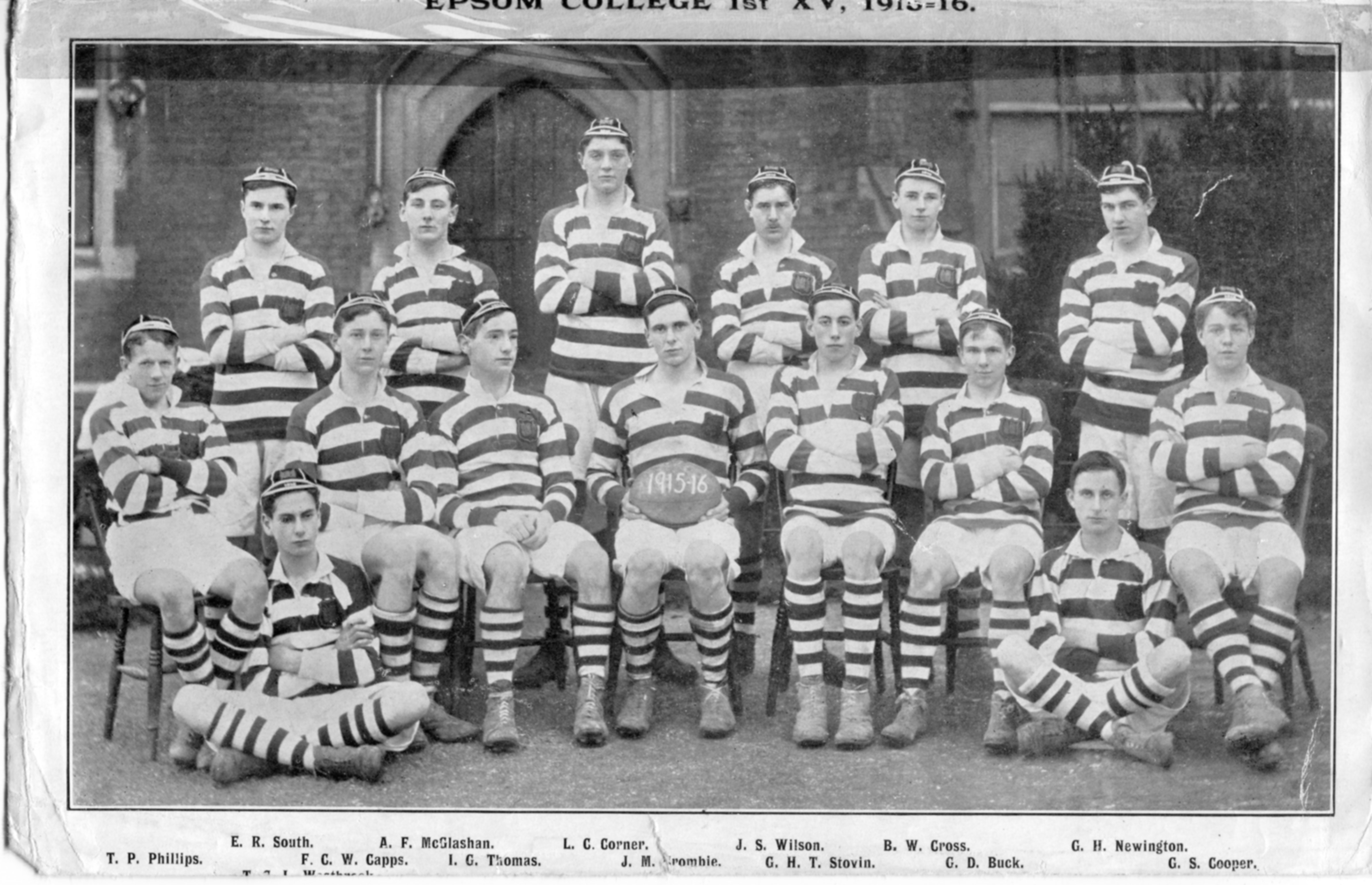
1915-1916 Rugby 1st XV (Epsomian)
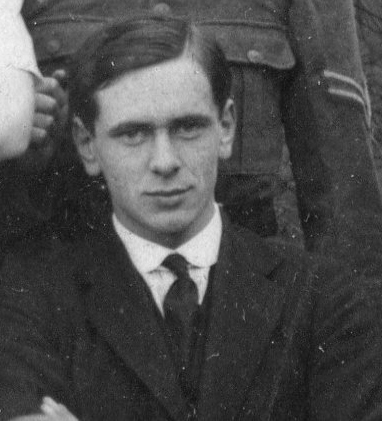
Crombie as Head Prefect 1916.
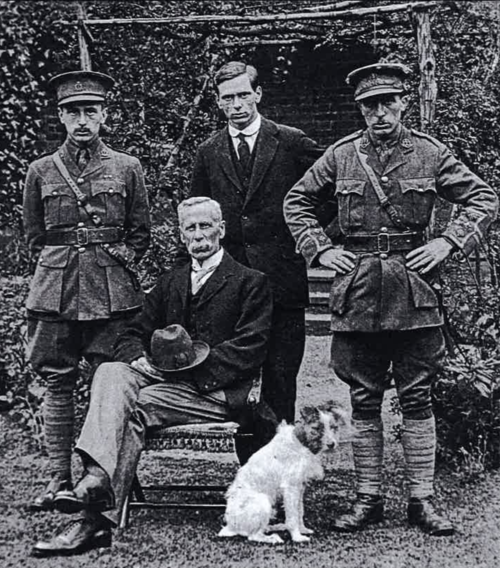
Crombie Brothers Sc Merton Court.
CROMBIE James MacHattie 2nd Lieutenant
3bn attd 10th Battalion Queen’s Own (Royal West Kent Regiment)
Died of wounds: 2 July 1917 aged 20
James was born on 23 June 1897 at Highden, Foots Cray, Kent (GRO ref Sept 1897
Bromley 2a 472), the third and youngest son of Dr James Crombie and his wife
Mary Martha Marshall nee Osborne.
In the 1901 census the family was living at Highden, Foots Cray, Kent.
James senior was a 44 year old general
practitioner trained in Edinburgh. Mary was 38. Five year old James had 3
siblings: Mary Gladys aged 9, William Maurice aged 7, and Ian Osborne aged 6.
They employed just a cook.
In the 1911 census the family was living in an 11 roomed house at 20, Hatherley
Rd, Sidcup. This was probably Highden as
a 1907 directory records a Highden in Hatherley Rd.
James senior was still working as a
general medical practitioner. His wife was 48.
Grace 19, Ian 16 and James 13 were at home on the night of the census.
The family employed a cook and a maid. The census confirmed that James and Mary
had had four children, all living.
James and his brothers were educated initially at Merton Court Preparatory
School, Sidcup and then he followed his brother William
to Epsom College, entering
Forest House as a Junior Scholar on 21 Sept 1911.
Throughout his time at Epsom he took a full and active part in school life. In
1913 he was made a joint Prefect with responsibilities in the Lower School,
a role he took
very seriously showing an interest in all that concerned the younger boys under
his care. In Michaelmas Term 1915, he
was made Head Prefect and exercised a very great influence in the school during
his last year. As Senior Prefect and Head Boy of his House he provided valuable
assistance to a new Housemaster, and led them to win the rugby shield. He also
inspired them by his example as the best gymnast in the school, and “showed the
way in everything towards soundness in mind and body.” He was an active member
of the Debating Society and on 21 October 1914 opposed the motion that “War is
not a misfortune”. He based his argument on the damage that war could cause to
nations’ economies and heritage and advocated that nations should settle their
disputes by arbitration. Unfortunately the motion was carried by a large
majority (18 to 4 in favour).
He
was Captain of Rugby 1915 having played for the first XV the previous year.
Epsom
College had assessed him as “Not brilliant, but a steady worker”. This is
perhaps a modest assessment of his achievements. He was always in the top third
of his form. He achieved his Lower School Certificate in 1912 with first class
passes in additional maths, arithmetic and latin. He passed his School
Certificate the following year, the Higher Certificate in 1914 and the Oxford
and Cambridge School exams in 1915. In June 1916 he cam top of the Sixth Form
and won a History Exhibition to Christ Church Oxford.
For
this success Epsom College awarded him the Armstrong Scholarship but did not
take up his Scholarship choosing an army career instead. He had been a keen
member of the OTC for five years, culminating in passing his Certificate “A”
exam in 1914 and became a Cadet Officer the following year. He had attended
camps at Aldershot, Tidworth and in 1915 in Richmond Park.
From 1915-1916 he was the School
Subaltern.
He had aspired to join the Army as an officer early in 1916, but because many
masters from Epsom college had left on war service and James was spending much
of his time training 130 boys in the OTC, the headmaster and Captain Lee who was
in charge of the College’s OTC were reluctant to release him as they thought he
would be equally well employed with the OTC. See correspondence below.
He attested as a Private on 29 February 1916 and was posted to the Army Reserve
on 1 March. He was discharged to join No 10 Officer Cadet battalion at Gailes as
an Officer Cadet on 1 Aug1916.
After
training in Ayrshire with the Officer Cadet Battalion, he was gazetted to a
commission in the Royal West Kent Regiment. London Gazette 8 Dec 1916 announced
that James would be 2nd Lieutenant (on probation).
He was sent to Flanders in January 1917
as part of the 123rd brigade, 41st division, 10 bn RWKR.
Old friends at the College were enabled to keep in close touch with his doings
by the interesting accounts he sent home of life in the trenches.
He
was admitted to No 7 Stationary hospital on 4 Mar 1917 with influenza and did
not return to duty until 28 March. At the end of June he distinguished himself
during the capture of Vimy Ridge. A few days later, on 25 June, he was badly
wounded while patrolling by night in front of British lines in Belgium, the
report in the Times says that he was wiring.. According to the article in the
Epsomian this was by machine gun fire, but the telegram from No 17 Casualty
Clearing Station at Remy Sidings, near Lijssenthoek stated that he had a shell
wound to his thigh. He was too ill to be transferred to Calais and UK and died
there at 14.45 on 2 July
a few days after his 20th birthday.
“His death, at the early where he died age of twenty, was a great sorrow to his
many friends at Epsom, where the memory of his leadership and example lives on.”
BH Epsomian.
He is also remembered on the Christ Church Oxford roll of honour.
Probate for his effects, valued at £266 6s 6d.was
granted to his father on 19 November. His belongings were returned from the
front which included a wrist watch and protector (damaged), I pair of
spectacles (damaged), 1 red ID disc, 1 flask, 1 clasp knife, 1 tie pin, 1
cigarette case, 2 collar badges, 2 cigarette holders (1 in a case), 1 cheque
book, 1 false tooth, 1 pair of pince nez spectacles in case 1 pencil, 1
stud, photos, 1 note case, 3 letters (2 damaged), 9 buttons and 2 stars.
A separate parcel was sent home containing a hair brush, shaving
brush, razors, shaving soap in a tin, a tin, a revolver in a case, a towel,
a handkerchief, a Sam Brown belt, a collar, a soap box, a tooth brush and a
mirror.
His brother, Ian Osborne Crombie, a Captain in the
Middlesex Regiment, was killed on the Somme 28 July, 1916. His eldest
brother William Maurice Crombie was a Captain in the Indian Medical Service
and died on 17 February 1919. He is buried in Sidcup.
All three are commemorated in Bexley and on the
Merton Court Prep School memorial.
Their father died on 30 March 1918 so only James’
mother and sister Mary Gladys survived the war years.
Sources
London Gazette 8th December 1916.
War Office, 8th December 1916. SPECIAL RESERVE OF OFFICERS.
The under mentioned, from Officers Cadet Units, to be 2nd Lieutenants (on probation):
Royal West Kent Regiment - James McHattie Crombie.
This page was last updated on 09-Sep-2023.
Copyright © 2008 Janet & Richard Mason